Make some stuff.
Particles, fields, energy, space. Keep the ingredients deliberately small.
It has particles. It has energy. It has a few rules. That’s about it.
The interesting part is what happens after we stop helping.
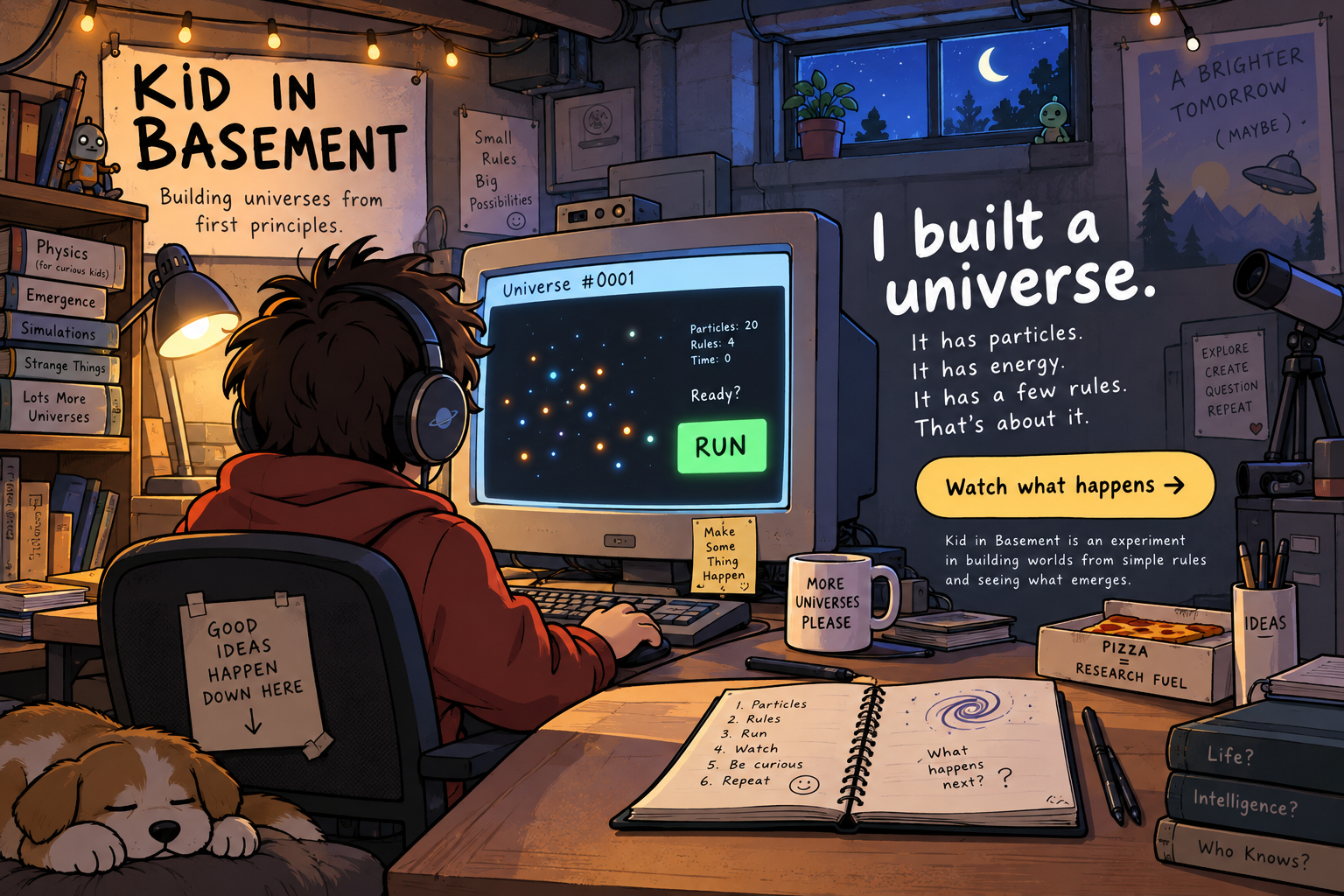
Start with very simple things, give them local rules, press Run, and see whether anything interesting appears that we did not explicitly design.
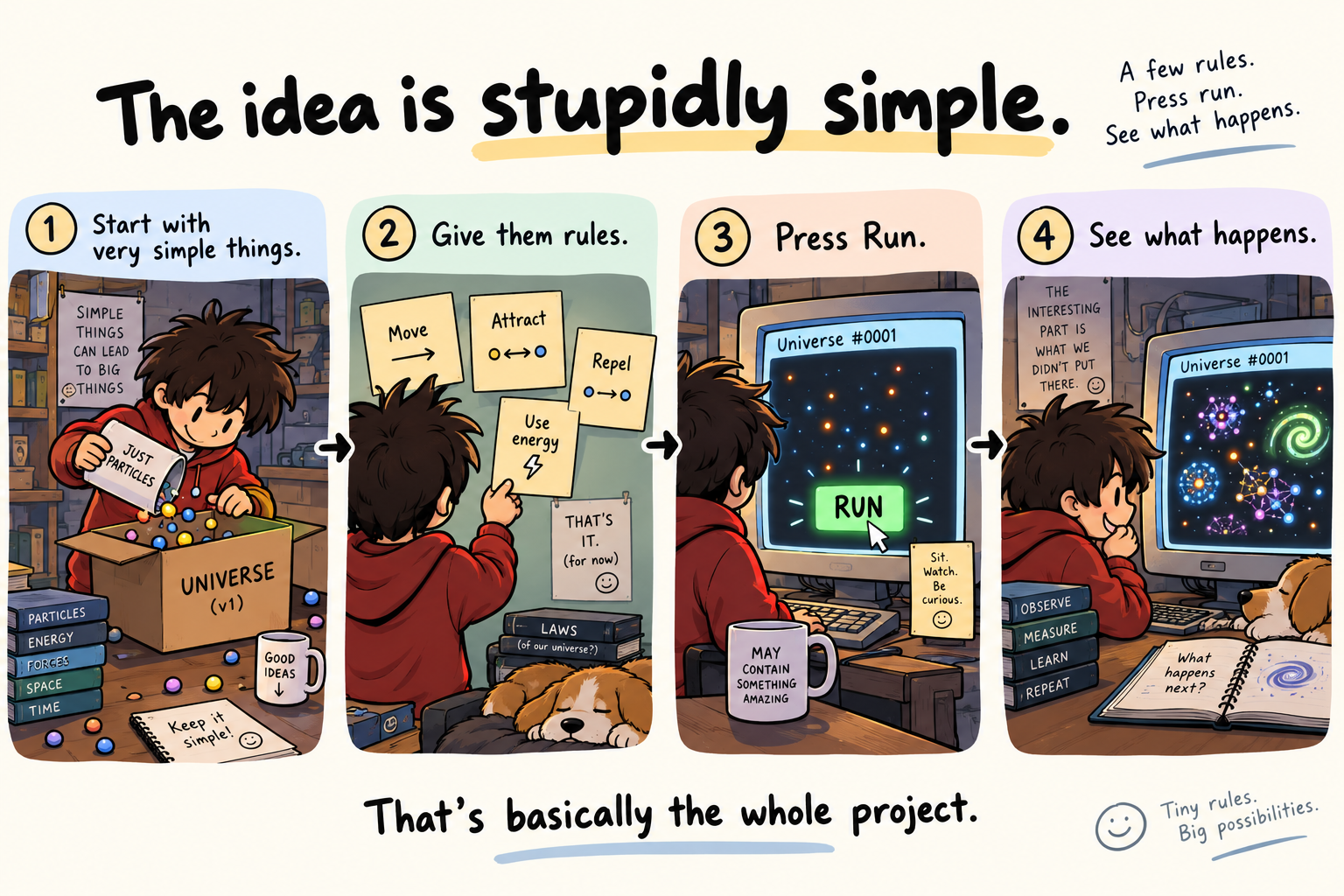
Particles, fields, energy, space. Keep the ingredients deliberately small.
Define how those ingredients may interact. Prefer local rules over global scripts.
Once the world begins, resist the urge to make the result more interesting.
Measure what persists, combines, copies, competes, adapts, or surprises us.
If we program a creature, we have built a creature. The harder and more interesting experiment is to program only the underlying world and see whether creature-like organization appears on its own.
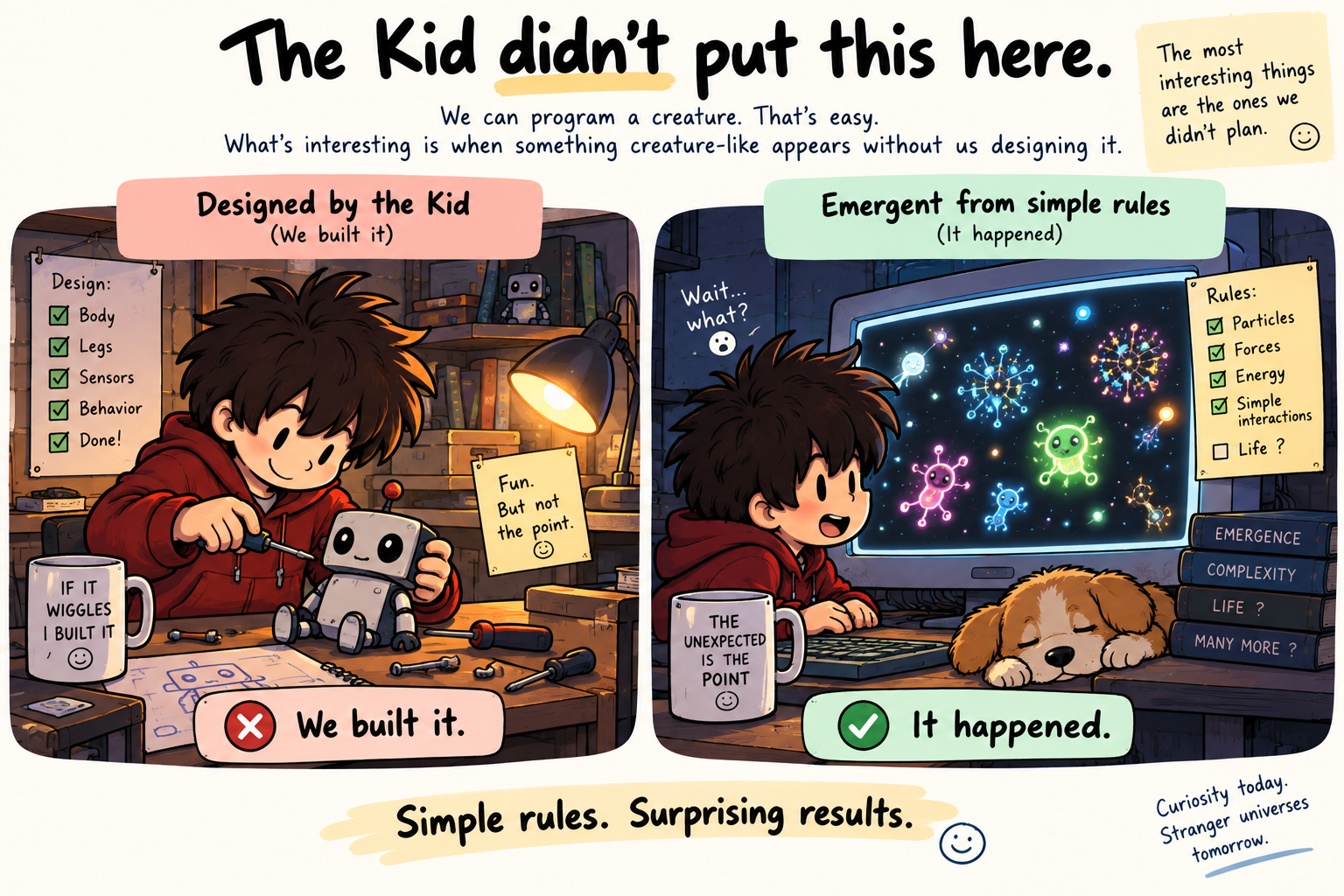
The temptation is to add cells, DNA, goals, organisms, species and evolution because those make a world look alive. We want to begin lower down the ladder.
The interesting things should make themselves.
Excellent. A negative result is still a result. We want a record of the dead ends, the explosions, the near-misses and the truly strange worlds.
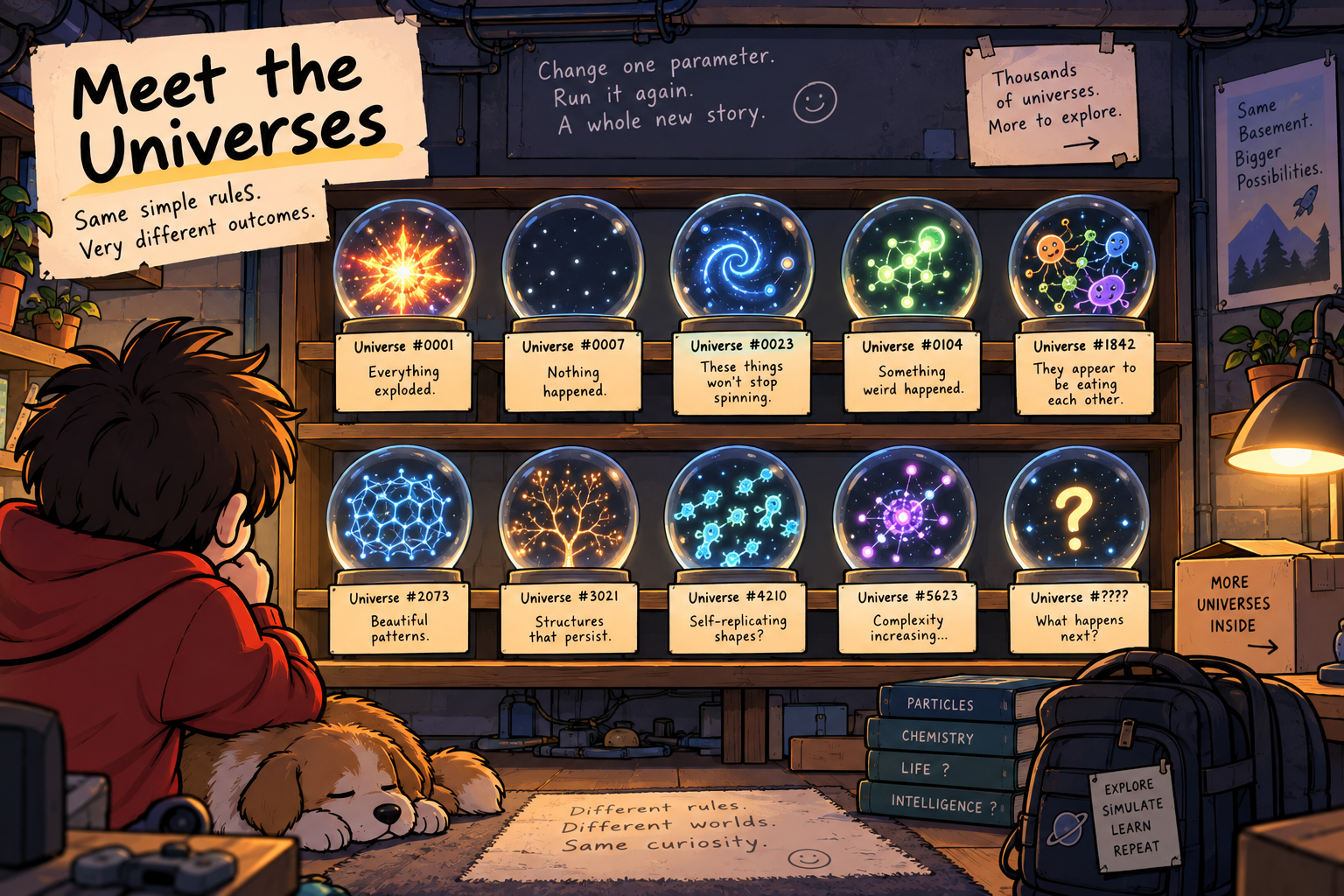
Too much attraction. Very short universe.
Stable, reproducible, profoundly dull.
Persistent rotational structures. Cause TBD.
Interesting enough to measure before naming.
Universe #1842: “They appear to be eating each other.”
These are not claims or promised milestones. They are simply useful rungs on the ladder from “dots moving around” toward richer organization.
Patterns that persist long enough to become objects worth studying.
Objects combining into stable arrangements with new behavior.
Structures using energy or resources to maintain themselves.
Structures producing descendants without a hard-coded “copy” command.
Heritable variation plus selection creating cumulative change.
Far beyond the present experiment. Still too interesting not to put on the wall.
A parameter casually chosen by a creator could look like a deep law of nature to an observer who exists entirely inside the world.
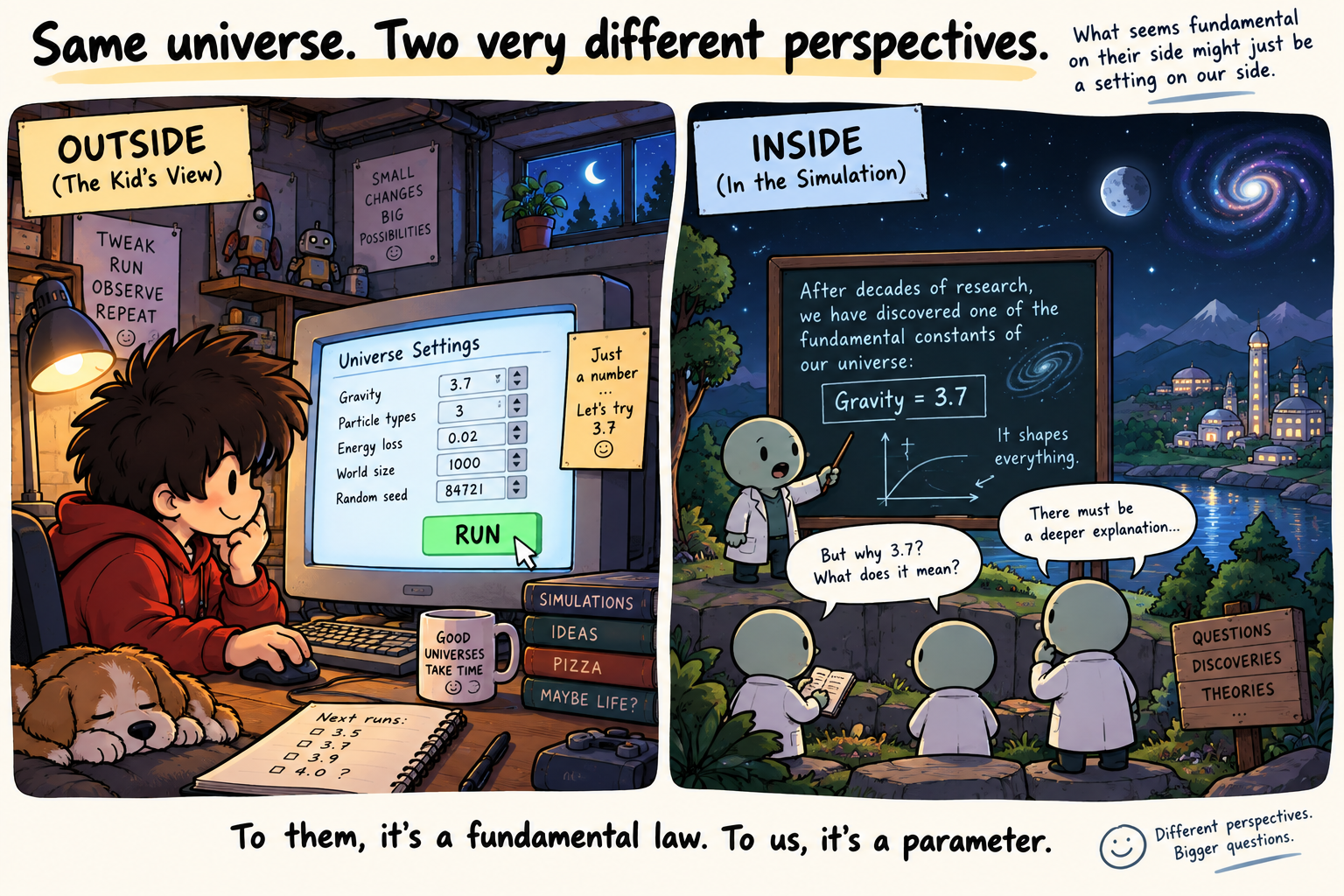
Our simulated inhabitants would inherit constants and rules too. To them, those rules would simply be reality.
Or can surprisingly rich global behavior arise from very small local interactions?
Before using the word, we should be explicit about which properties we actually observed.
We do not expect the simulations to answer these questions. We hope they make the questions better.
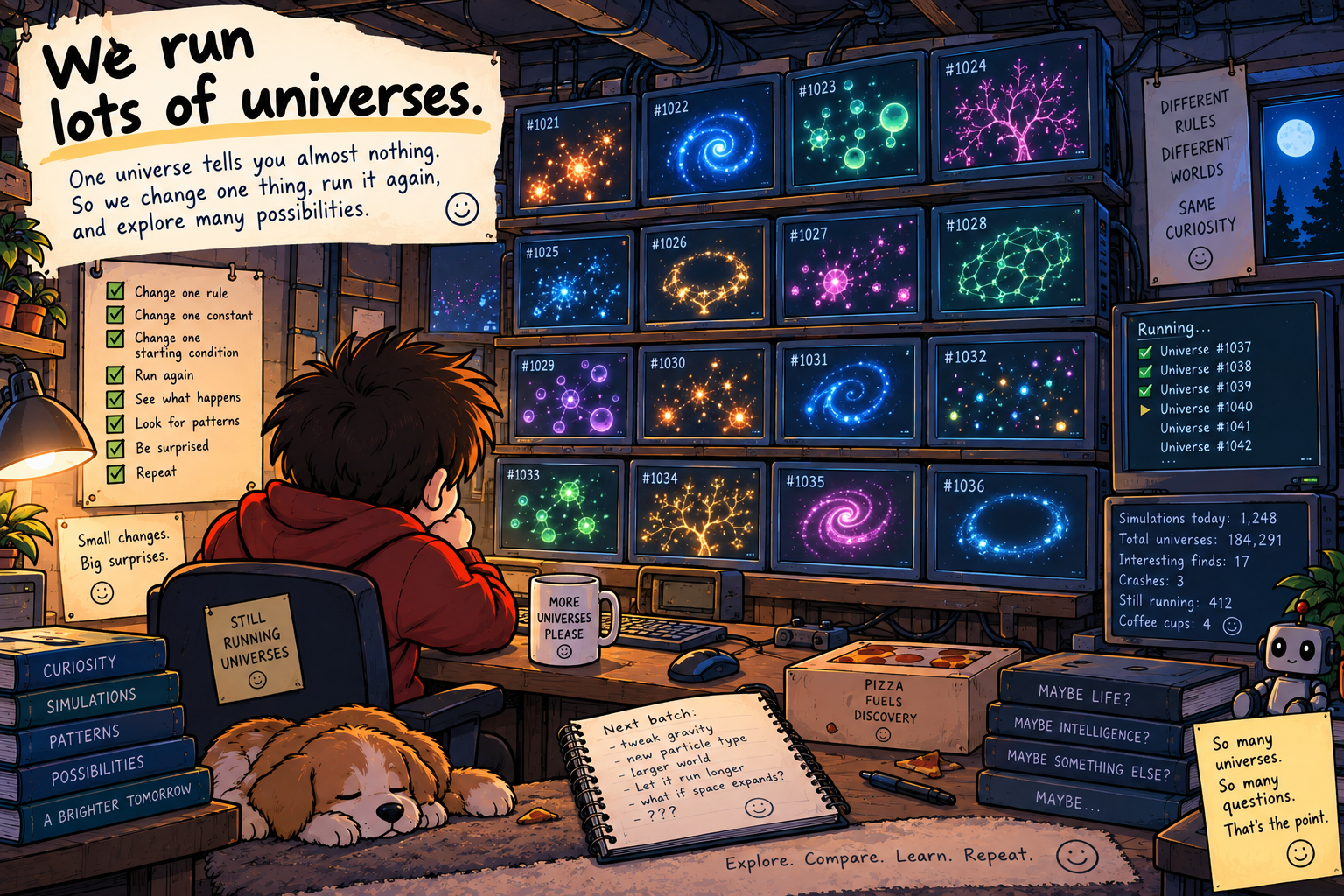
Change one rule. Change one constant. Change one starting condition. Run it again. Then compare what changed and what stubbornly stayed the same.
The point is not to find the prettiest universe. It is to understand which kinds of rules repeatedly create which kinds of behavior.
KIB can become more interesting if people contribute different kinds of attention: observations, ideas, code, analysis, visualizations, criticism and eventually spare compute.
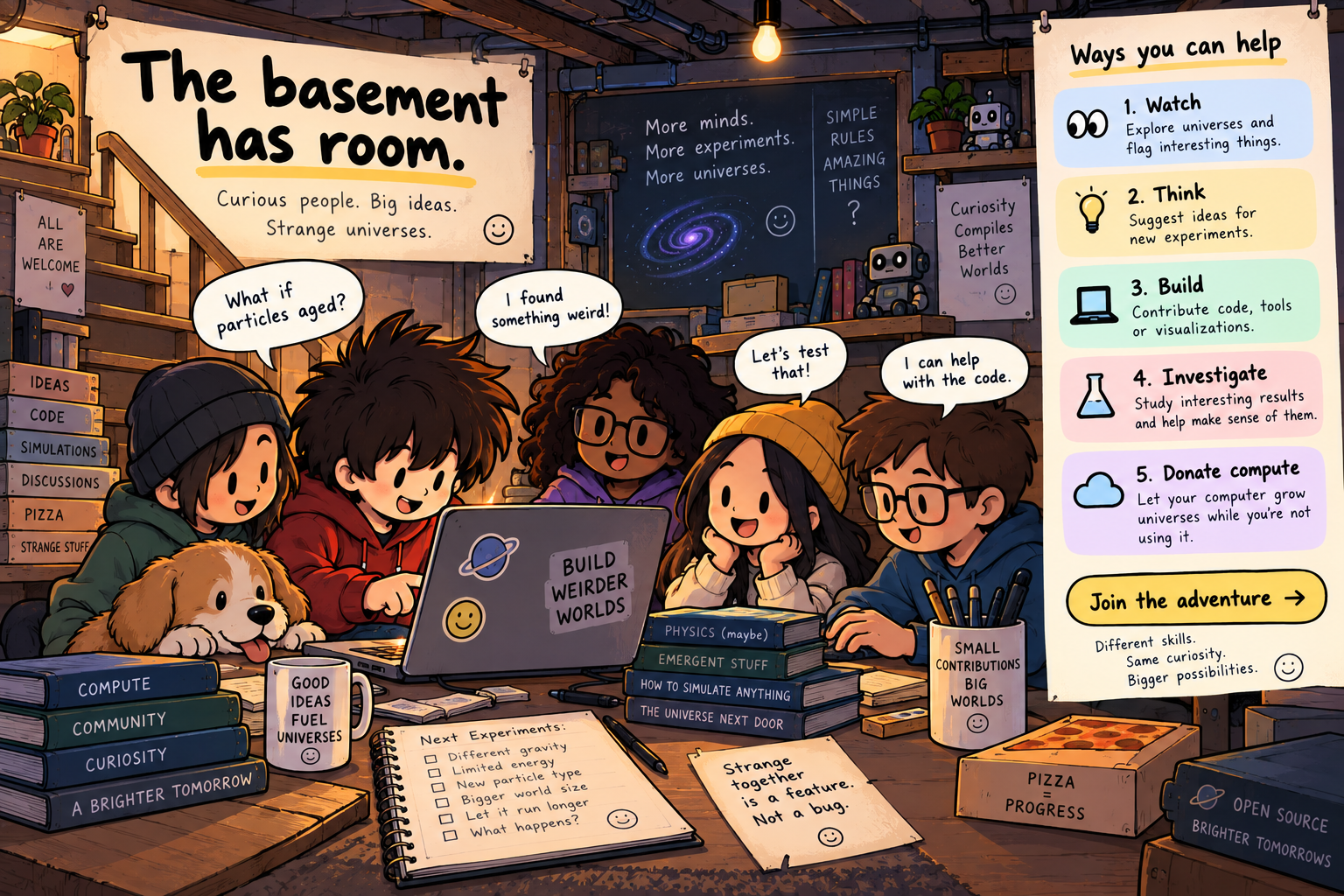
Explore runs and flag structures or behavior that seem genuinely unusual.
Suggest experiments, simpler rules, better measurements or reasons our interpretation may be wrong.
Contribute simulation code, analysis, visualization, tooling or infrastructure.
Take one interesting run apart and try to explain what actually happened.
Later, idle machines could help explore more of the rule-space.
“I think you’re fooling yourselves, and here’s how to test it.”
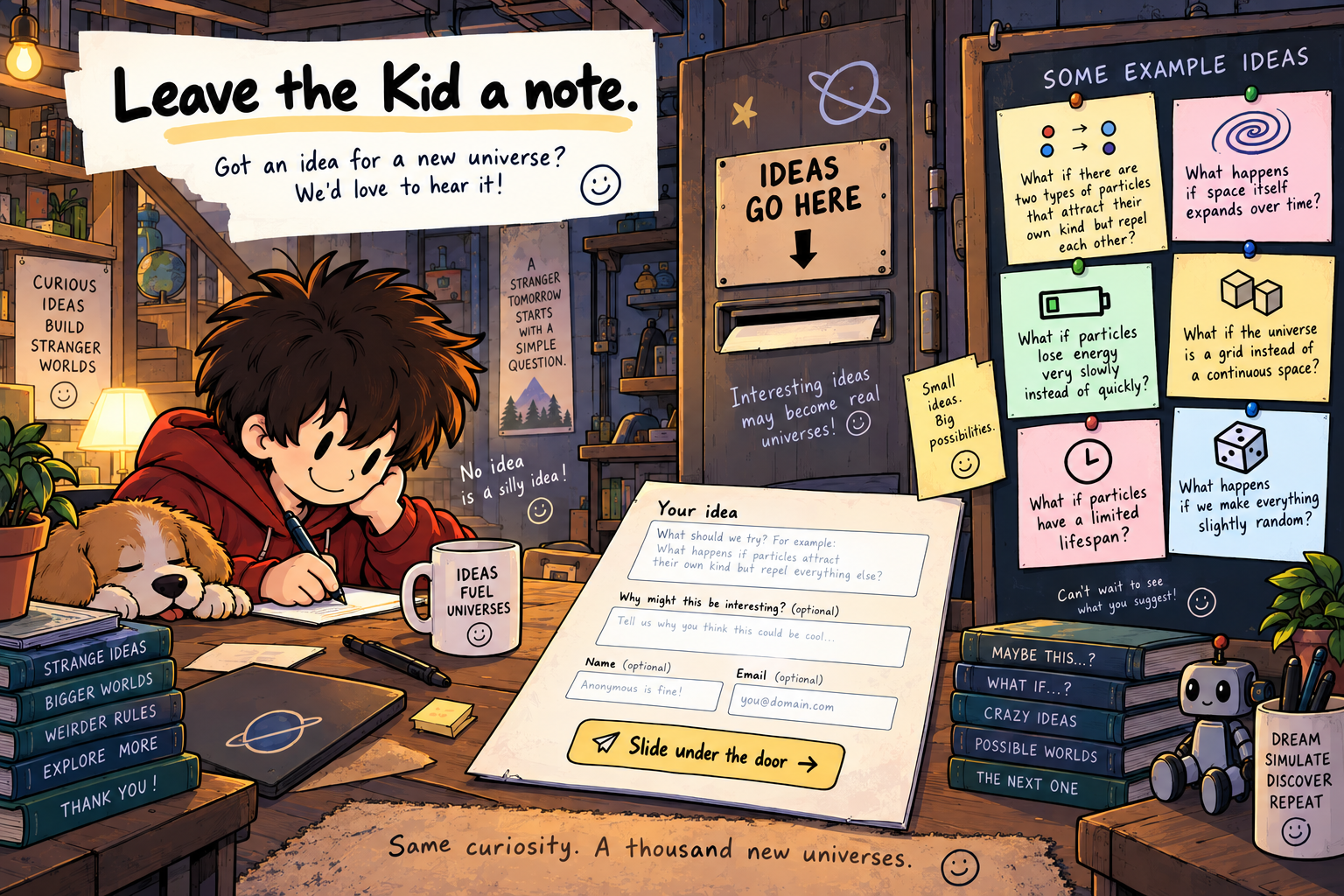
A good suggestion does not need to be complicated. “What if particles aged?” is enough. We can worry about the experiment design afterward.
If we put a behavior in, say so. “Emergent” should not be a marketing word.
Interesting behavior and life are not synonyms.
Most anomalies will be bugs, artifacts or ordinary statistics.
A universe where nothing useful happens still constrains the search.
Rules, seeds, parameters, code and observations should be inspectable.
The goal is not “wow.” The goal is understanding why the wow happened.
Many universes. A ridiculous number of possibilities. One stubborn question: what can simple rules build when nobody tells them what to become?
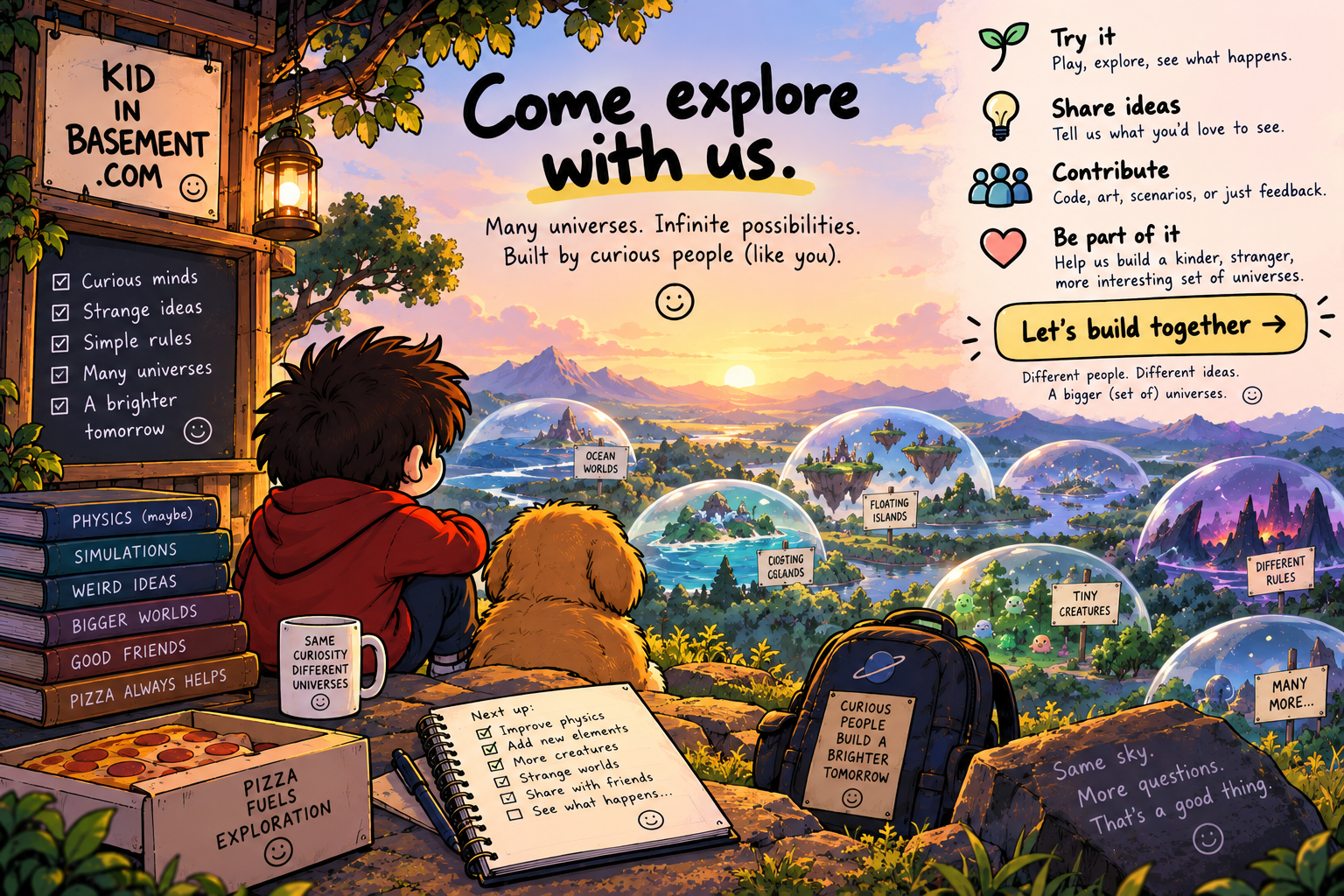
The Kid made a universe.
The universe made something interesting.
The interesting thing started wondering where it came from.